
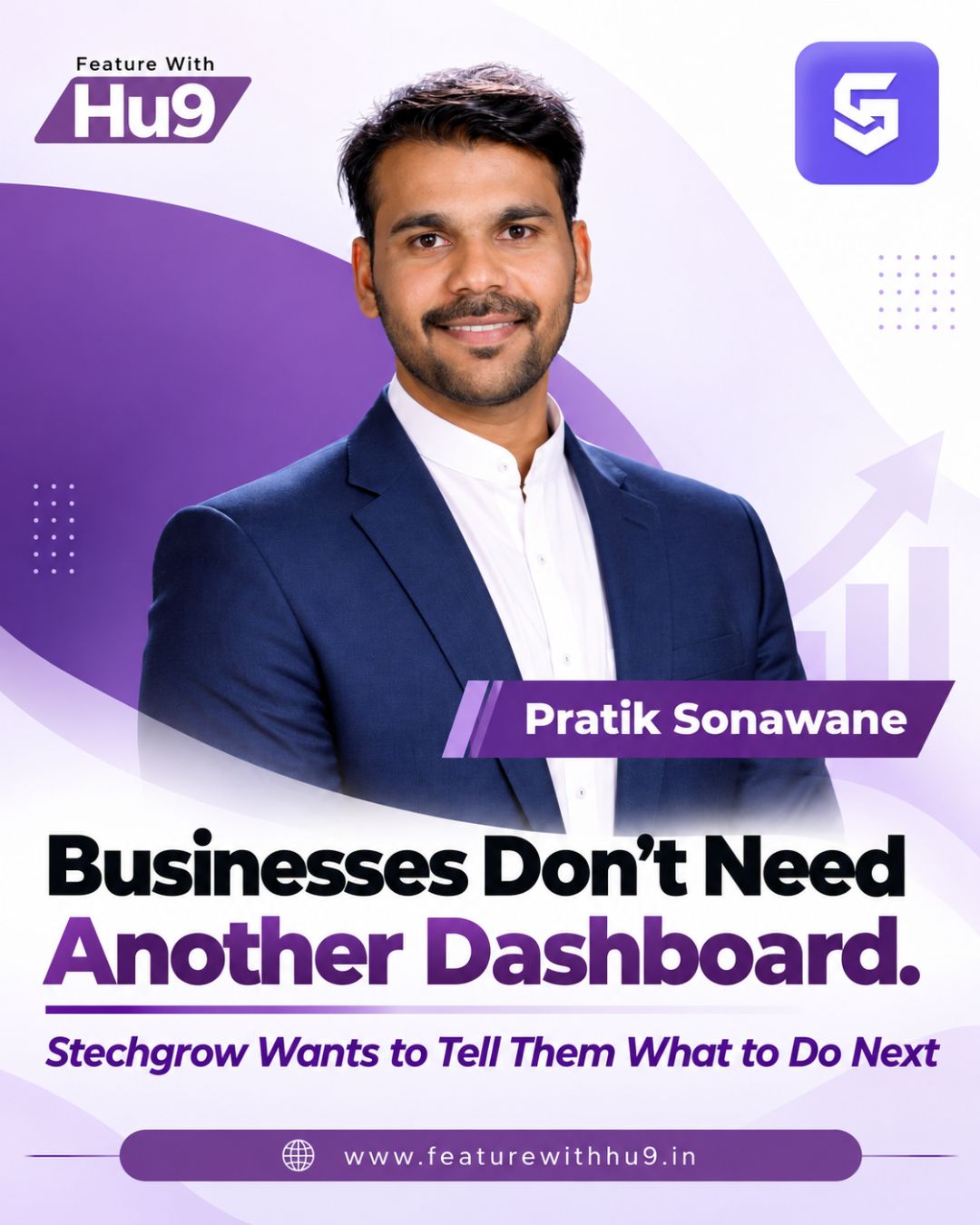
Businesses Don’t Need Another Dashboard. Stechgrow Wants to Tell Them What to Do Next
Mumbai founder Pratik Sonawane is developing an AI-powered platform that moves beyond reporting to help growing businesses interpret fragmented data and act on it.


This founder feature was prepared by Feature With Hu9 using information shared by the founder or business and editorially structured for publication.
Businesses today rarely suffer from a shortage of data. Their numbers are often distributed across Excel sheets, accounting software, CRM systems, sales platforms and marketing tools. The difficulty lies in bringing this information together quickly enough to make a useful decision.
Pratik Sonawane, Founder and CEO of Mumbai-based Stechgrow, believes this gap cannot be addressed by simply adding another dashboard. His company is developing an AI-powered data analytics and decision intelligence SaaS platform intended to help businesses understand not only what is happening, but also why it is happening and what they should do next.
That distinction forms the central idea behind Stechgrow. Instead of presenting more charts for founders and teams to interpret, the platform aims to convert scattered business data into clear, actionable intelligence.
The question behind Stechgrow
The idea began with a question that Sonawane kept returning to: why do businesses possess so much data and still struggle to make confident decisions?
To understand the issue beyond his own observation, he discussed it with industry experts and business professionals. Their experiences pointed to a recurring operational problem. Teams were spending hours preparing reports, moving between multiple tools and trying to reconcile information, yet the final output did not always provide clear or actionable insights.
These conversations convinced Sonawane that there was room for a simpler approach. Stechgrow emerged from that combination of personal curiosity, discussions with people facing the problem and a belief that AI could make business decision-making faster and clearer.
Fragmentation has a business cost
When business data sits across disconnected tools, reporting becomes a manual exercise. Teams must collect, organise and interpret information before they can even begin discussing a decision. By the time a report is ready, an early indication of a problem or growth opportunity may already have been missed.
According to the problem Stechgrow is addressing, these delays can contribute to lost revenue, unnecessary expenditure, inefficient allocation of resources and slower growth. The underlying issue is therefore not merely technical integration. It is the inability to turn available data into timely intelligence that supports action.
For startups and SMEs, where decisions often have to be made with limited time and resources, the difference between receiving data and understanding its implications can be significant.
Moving beyond the rear-view mirror
Traditional dashboards are generally effective at showing what has already occurred. But a chart indicating a fall in sales or an increase in spending still leaves the user with two important questions: why did this happen, and what should be done about it?
Stechgrow is being designed around those questions. By combining data analytics, AI and decision intelligence, the platform seeks to interpret business performance rather than stop at visualisation. Its intended role is closer to an intelligent decision partner than a conventional analytics product.
This is also the company’s main point of differentiation. The focus is not on adding more layers of technology for users to navigate, but on aligning the product with the way founders assess problems, weigh priorities and decide on their next steps.
Simplicity proved harder than analytics
One of Stechgrow’s biggest challenges has been translating a complex AI and analytics concept into a product that businesses can use without being overwhelmed.
Early conversations revealed that many users already found conventional dashboards difficult to interpret. Even after receiving the required numbers, they still had to spend time determining what those numbers meant. This presented an important product lesson for Sonawane: more data does not automatically produce better decisions.
The company has since concentrated on simplifying the experience and building around actual business decisions rather than reporting alone. Listening to customer feedback is part of that process. The objective is to ensure that the product reduces the work required to reach an answer instead of introducing another complicated system.
Institutional support during the build phase
Stechgrow has been incubated at TBIF–IIT Ropar, giving the company access to a startup ecosystem, mentorship and institutional support as it develops the business. It has also received recognition under Startup India.
These milestones arrive while the company remains focused on completing its product and preparing for the market. At this stage, the more consequential test will be whether its decision-intelligence approach can fit naturally into the day-to-day operations of startups and small and medium enterprises.
The next three months are about real-world use
Stechgrow’s immediate plan is to complete and launch the platform over the next three months. During the same period, Sonawane intends to onboard the company’s first startups and SMEs as paying customers and gather feedback from their use of the product.
That feedback will be used to improve the platform and strengthen its AI-driven decision intelligence capabilities. The company also plans to work towards a repeatable customer acquisition process, with sustainable growth as the longer-term objective.
This phase will move Stechgrow’s founding premise from conversations into practice: whether fragmented operational data can be turned into answers that founders find clear, timely and useful.
Stechgrow is being built around a restrained but important product insight: visibility is not the same as understanding. A business can have extensive data and polished dashboards while remaining uncertain about its next move.
Sonawane’s challenge is now to make sophisticated analytics feel simple without reducing the value of the underlying intelligence. As Stechgrow approaches launch, its progress will depend on whether it can consistently bridge the distance between seeing a number and making a decision.