
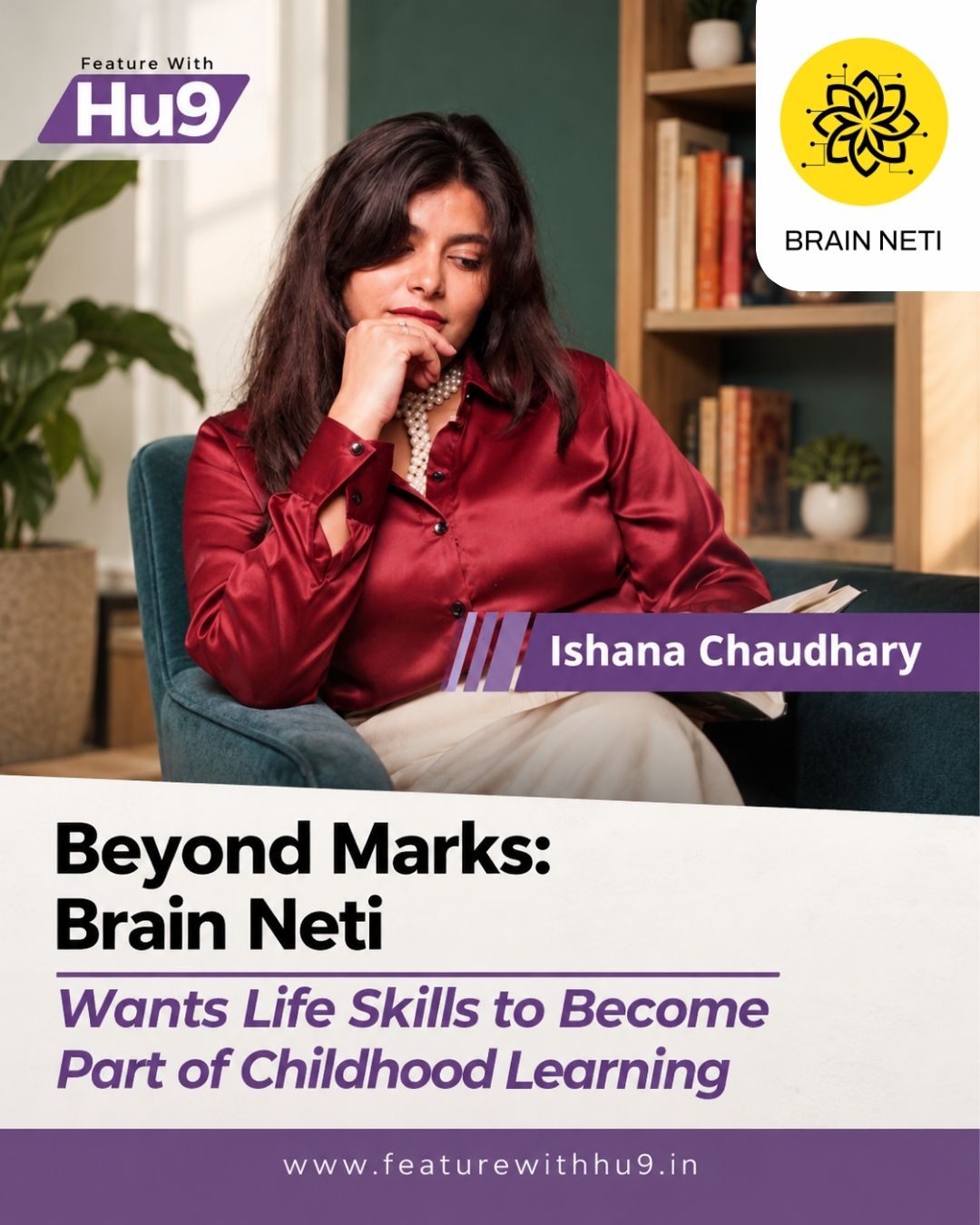
Beyond Marks: Brain Neti Wants Life Skills to Become Part of Childhood Learning
Isshana Chaudhary’s platform works with children and parents to address attention, emotional regulation, confidence and everyday decision-making.

This founder feature was prepared by Feature With Hu9 using information shared by the founder or business and editorially structured for publication.
Children are routinely taught what to learn. Brain Neti begins with a different question: are they also being taught how to focus, regulate emotions, make decisions and respond to everyday challenges?
That distinction sits at the centre of the Mumbai-based edtech platform founded by Ishana Chaudhary. Designed for children aged five to 13, Brain Neti focuses on capabilities that may not fit neatly into conventional academic measures—attention, emotional intelligence, self-control, critical thinking, confidence, social skills and decision-making.
Its premise is that child development cannot be separated from the environment at home. Alongside structured activities and guided learning for children, the platform offers parents practical strategies to understand behaviour, manage challenges and build stronger relationships. This combined focus on the child and parent reflects Brain Neti’s central belief: lasting developmental change requires more than a standalone class or activity.
The gap hidden behind academic achievement
The idea for Brain Neti emerged from a perceived imbalance in childhood education. Children may receive extensive instruction in academic subjects, yet have fewer structured opportunities to understand their emotions, control their attention or work through difficult decisions.
At the same time, parents may see concerns such as screen dependency, low confidence, poor emotional regulation or challenging social behaviour without knowing how to respond in practical ways. Brain Neti was conceived to address these connected needs rather than treating them as separate issues.
The platform’s mission is therefore not to replace academic learning, but to go beyond it. It aims to help children develop the internal and interpersonal skills required to navigate life with confidence and resilience, while giving parents clearer ways to support that process.
Why the parent is part of the programme
A distinguishing element of Brain Neti’s model is its inclusion of parents in the development journey. Programmes aimed at children can have limited continuity if the ideas introduced during guided sessions are not understood or reinforced at home.
Brain Neti combines child-focused learning with parent counselling and engagement. The intention is to help parents better interpret their children’s behavioural needs and use practical strategies when difficulties arise. This approach also recognises that attention, self-control and emotional responses do not appear only in a learning session; they play out in routines, relationships and daily choices.
By working on both sides of that equation, the platform seeks to create a more supportive setting for sustained behavioural and emotional development.
Turning broad life skills into structured activities
Terms such as confidence, critical thinking and emotional intelligence can be broad. Brain Neti’s work involves translating them into structured learning modules and practical activities suited to children aged five to 13.
Its science-informed approach brings together cognitive activities, emotional development, behavioural conditioning and parenting guidance. The focus is not solely on what children know, but on how they think, feel, behave and respond to real-life situations.
Brain Neti has designed child development modules and created practical learning activities across its focus areas. It has also developed parent counselling and engagement programmes. Together, these components form the foundation of an approach intended to build essential life skills rather than concentrate only on academic performance.
The harder lesson: changing what adults value
For Brain Neti, developing the programme is only one part of the challenge. The other is building awareness among parents that development extends beyond marks.
Academic performance remains a priority for many families, while attention, emotional regulation, confidence and behavioural skills can be overlooked. As a result, communicating the long-term value of working on these areas—and building trust around the process—has been a significant task for the company.
Brain Neti is addressing this perception gap through parent education, practical activities and collaborations with schools and communities. This awareness-building is central to its plans because families must first recognise these capabilities as learnable and worth nurturing before they are likely to engage with a structured programme.
Schools as a bridge to wider access
Brain Neti has built a framework for school collaborations, reflecting the role educational institutions can play in bringing life-skills development into a more familiar setting. School partnerships could also connect the platform with parents and children through an institution already involved in their learning journey.
The company is now focused on expanding its reach through schools, parents and community partnerships. Its next phase includes strengthening programme delivery and building institutional relationships, alongside continuing its work with families.
This direction aligns with Brain Neti’s broader ambition to make science-informed child development accessible to more children across India. Rather than positioning life skills as an isolated add-on, the platform is working towards an ecosystem in which children, parents and institutions participate.
Building towards a measurable ecosystem
Brain Neti’s future plans include digital learning solutions, interactive activities, parent counselling and progress tracking. The aim is to create a structured and measurable child development ecosystem rather than a collection of disconnected resources.
Scaling through strategic school partnerships and parent programmes is another priority. As the platform expands, it plans to strengthen how its programmes are delivered while developing the systems needed to track children’s progress.
The ambition is broad, but the underlying focus remains specific: helping children develop attention, emotional intelligence, self-control, critical thinking, confidence, decision-making and social skills, while equipping parents to support those capabilities in everyday life.
Brain Neti is built around a straightforward but consequential observation: academic instruction alone does not prepare a child for every challenge that childhood—and later life—will present. Its work now lies not only in delivering activities and guidance, but also in persuading families and institutions to give emotional, cognitive and behavioural skills a more deliberate place in learning. If that shift takes hold, the conversation about a child’s progress may gradually expand beyond marks to include how well they understand themselves, relate to others and make their way through the world.