
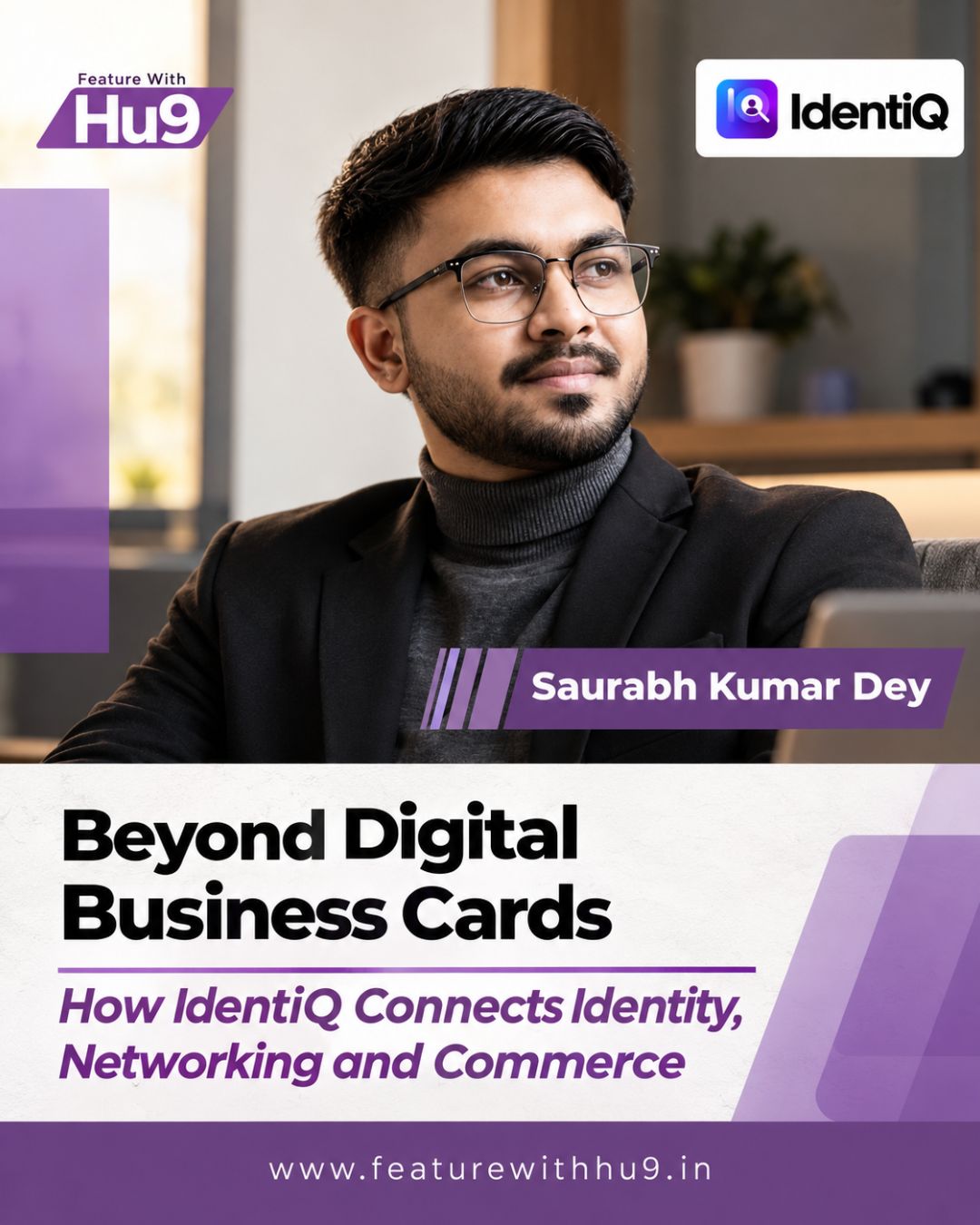
Beyond Digital Business Cards: How IdentiQ Connects Identity, Networking and Commerce
From Varanasi, solo founder Saurabh Kumar Dey is bringing identity, networking and professional growth tools onto one platform.

This founder feature was prepared by Feature With Hu9 using information shared by the founder or business and editorially structured for publication.
Sharing contact details takes seconds. Communicating the full scope of one’s professional identity—and converting that introduction into a useful connection or commercial opportunity—is considerably more difficult. A visiting card may provide a phone number, while social platforms, portfolios, websites, commerce tools and booking systems each hold another part of the picture.
This fragmentation is the central problem behind IdentiQ, a SaaS platform founded by Saurabh Kumar Dey in Varanasi. Rather than treating digital identity as a static profile, Dey is developing IdentiQ as a working professional layer: a place where users can present their work, share details, capture leads, sell products, offer paid consultations and engage audiences through events.
A professional identity scattered across platforms
The idea for IdentiQ emerged from Dey’s observation that professional identity rarely exists in one place. Visiting cards carry basic contact details, social media accounts show selected aspects of a person’s work, portfolios demonstrate capabilities, and separate websites or communication channels handle enquiries. Commerce, consultations and events may require still more tools.
For professionals, freelancers, creators, founders and small businesses, managing this collection can become expensive, complicated and time-consuming. More importantly, fragmentation can create a gap between being visible and generating a meaningful outcome from that visibility.
Dey’s response was not simply to digitise the visiting card. He wanted to create a platform where people could represent themselves more completely and use that identity to connect with others and develop business opportunities.
The business card is only the entry point
IdentiQ allows users to create customisable professional profiles containing portfolios, social links and other relevant information. These profiles can be shared through QR codes and NFC-enabled cards, connecting a physical interaction with a digital presence.
That combination addresses one limitation of the conventional visiting card: once printed, it remains static. A digital profile can present a wider professional picture and support different forms of engagement. IdentiQ also includes lead capture forms and analytics, giving users tools to understand and manage the interest generated through their profiles.
The platform therefore treats the exchange of contact information as the beginning of an interaction rather than its final objective.
From an introduction to a commercial opportunity
IdentiQ’s defining product choice is to place business functions alongside identity and networking. Its native Store enables users to showcase and sell products. The Consultation feature allows professionals to offer their expertise through paid sessions, while Events capabilities are intended to help users connect with and engage their audiences.
The significance of this approach lies in reducing the distance between discovery and action. A creator or small business need not direct an interested contact across several unrelated platforms to view work, find a product or explore a consultation. These functions sit within the same broader professional presence.
For Dey, this is what separates IdentiQ from a conventional digital business card: the aim is not merely to exchange information, but to connect identity with practical avenues for visibility, engagement and revenue.
Building an all-in-one product without a large team
The breadth of that product vision also creates IdentiQ’s most immediate challenge. Dey is building the company as a solo, bootstrapped founder, without investor backing or a large team. His responsibilities span product development, technology, marketing, sales, customer acquisition and business operations.
Limited financial resources make prioritisation central to the process. Every proposed capability must be weighed against what can realistically be built and sustained. That tension is particularly pronounced for a platform attempting to combine digital identity, networking, commerce, consultations and events.
Dey says the experience has required continuous learning and resourcefulness. At the same time, independent ownership has allowed him to retain control over the product’s direction and develop it around user needs rather than external expectations.
Linking online profiles with real-world meetings
IdentiQ’s physical NFC cards form an important bridge between digital presence and in-person networking. A meeting can begin with a card or QR code, but the recipient is directed towards a profile capable of carrying more context than printed material can accommodate.
Dey has continued expanding this connection between physical and digital interactions while developing the wider product ecosystem. The working platform now brings together profile creation, portfolio presentation, QR and NFC-based sharing, lead capture, analytics, a native Store, paid consultations and event-related capabilities.
For him, taking IdentiQ from an initial concept to a functioning platform as an independent founder is itself a significant achievement. The work now involves improving both its functionality and its commercial potential.
The longer ambition: identity that travels
Dey’s long-term vision is for professional identity to become portable, dynamic and accessible across geographies and industries. He sees IdentiQ evolving into a digital identity and networking layer through which people and businesses can represent themselves, discover others and form professional relationships across online and physical settings.
That ambition extends beyond profiles. In Dey’s view, identity should support the complete progression from presenting one’s work and exchanging information to building connections, selling products, offering consultations and creating opportunities.
As a bootstrapped founder, however, his stated focus remains sustainable development: strengthening the foundation, expanding the platform’s capabilities and working towards international adoption without losing sight of what can be built responsibly.
IdentiQ is built around a straightforward but consequential observation: professional identity is more useful when it can lead somewhere. Dey’s task is to turn that observation into a coherent platform without allowing an ambitious feature set to become another form of complexity. If IdentiQ’s next phase can preserve that coherence, its evolution will be shaped not by the digital card it replaces, but by the opportunities a connected professional presence can enable.