
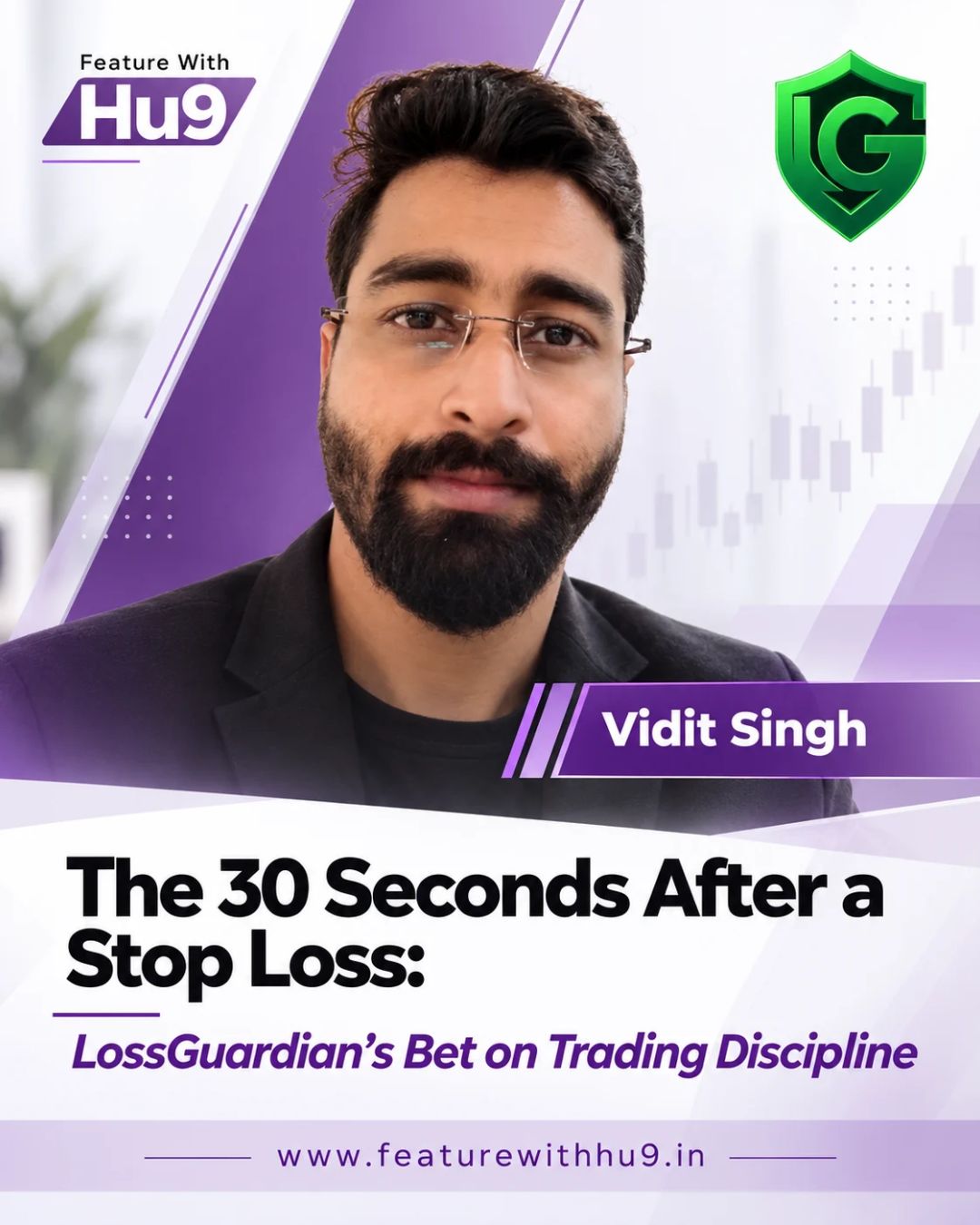
The 30 Seconds After a Stop Loss: LossGuardian’s Bet on Trading Discipline
Vidit Singh built a read-only risk management app around the brief window in which retail traders often abandon their own rules.


This founder feature was prepared by Feature With Hu9 using information shared by the founder or business and editorially structured for publication.
For Vidit Singh, the recurring weakness in his options trading was not market analysis. It was the 30 seconds after his first loss.
His journal recorded a familiar pattern: a stop loss would be hit, the next trade would be taken too quickly, and the position would become bigger in an attempt to recover the loss. Singh could recognise the mistake at the end of the day, write it down and promise not to repeat it. Yet the same cycle could begin again the following morning.
That gap between knowing a rule and following it became the basis for LossGuardian, a risk management application for Indian retail traders. Instead of helping users discover trades, the product concentrates on the point at which discipline starts to weaken. It connects to supported brokers, monitors live profit and loss, and applies rules that the trader sets before the market opens—while leaving every actual trading decision with the user.
When a journal was not enough
Vidit, a Noida-based software engineer and active F&O trader, initially built the system for himself. His trading journal made the problem visible, but it could only document a lapse after it had happened. It could not intervene when emotions began influencing the next decision.
This led him to a simple conclusion: rules kept in a trader’s head or notebook are easy to override. Willpower is often weakest at precisely the moment it is most needed. Using his software background, Vidit began creating a system that could hold him to a plan made before the pressures of a live session took over.
The project moved beyond a personal tool after conversations with other traders revealed similar experiences. LossGuardian subsequently became a product under Liquidity Trader Media and Tech Pvt Ltd.
A product focused on the trade after the loss
Most trading products are designed to assist with market analysis or identify possible entries. LossGuardian takes a narrower position: it is concerned with what happens after a trader begins drifting from a predefined process.
A user connects a broker account and sets rules before the session. The application then watches live P&L. If the daily loss limit is reached, it issues a hard-stop alert designed not to disappear through a routine dismissal. It can also introduce warnings and cool-down locks when it detects behaviours such as rapid trading after a loss or a potential revenge trade.
Rules are locked once the session begins, preventing a trader from quietly changing a limit during a losing streak. Each session is also auto-journaled and receives a discipline score, giving users a record of where their actions departed from their plan.
Guardrails without order execution
The central product challenge was to protect traders without taking control of their accounts. Singh says SEBI compliance requirements around API-based order execution shaped the design: LossGuardian does not place or cancel orders, and it does not make the final trading decision.
Instead, it operates as a read-only layer built around visibility, friction and timely intervention. Broker authentication takes place on the broker’s own screen, meaning LossGuardian does not see the user’s broker password.
This boundary is important to the product’s premise. The application is not an automated trader or an execution engine. Its role is to make the user’s pre-committed rules difficult to ignore when a loss creates the temptation to abandon them.
Six brokers, managed from one place
LossGuardian currently supports Zerodha, Fyers, Dhan, Upstox, Angel One and Groww. Vidit says Zerodha, Fyers and Dhan are connected through official integrations.
He built the entire stack himself, including the real-time risk engine, session journal and discipline score. The live product offers paid plans alongside a seven-day free trial.
Building across multiple brokers gives traders a single place to apply and review their risk process. At the same time, the product avoids claims about generating profits. Singh’s stated focus is on process: helping traders become more disciplined and mentally resilient through a systematic framework rather than depending on willpower alone.
The economics of building alone
LossGuardian is being developed and marketed by Singh as a solo founder with what he describes as almost no budget. That makes distribution a challenge alongside engineering. Every hour and every rupee must be allocated between improving the product and finding the traders who may need it.
His present distribution efforts include content and community-building through The Liquidity Trader on YouTube, Instagram and X. The business plans to grow paid usage through this content and through word of mouth among Indian F&O traders.
The approach reflects the product’s origin: LossGuardian is being presented through the same trading behaviours and difficult sessions that led Singh to build it, rather than through promises of better returns.
Success would mean needing it less
The next product layer will expand the journal. Planned features include quick notes for individual trades, setup and emotion tags, and an AI-based capability intended to examine a trader’s history and surface patterns that may be difficult to identify manually.
Singh also plans to add more brokers and simplify installation so that a trader can set up protection within minutes of downloading the application.
His longer-term product goal contains an unusual tension for a subscription software business: the ideal trader should need Loss Guardian less with each passing month. If the guardrails work as intended, repeated intervention should gradually give way to stronger habits and a more consistent process.
LossGuardian is built around a modest but consequential observation: a trading plan is only as useful as a trader’s ability to follow it under pressure. Singh is not trying to predict the next market move or remove human choice from trading. He is concentrating on the short, emotionally charged interval in which a planned process can unravel. Whether that intervention can translate into durable habits will determine the product’s value and shape its next stage of growth.